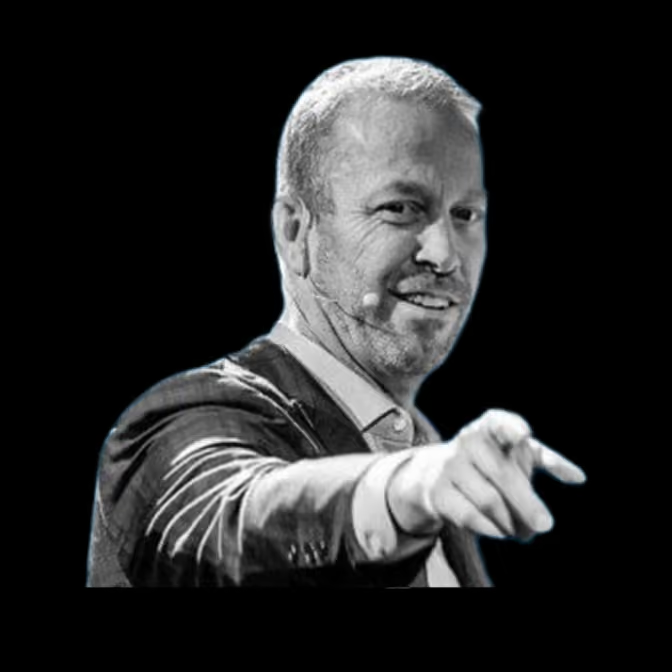
Josh Dorfman: Co-founder and CEO of SuperCool
In this episode of Retain Grow Thrive, Joe Fox, President at Growave, speaks with Josh Dorfman, CEO and Founder of Supercool.
Josh shares his journey as a climate entrepreneur and explains how climate innovation is moving from experimental ideas to real commercial solutions. The conversation explores how businesses can adopt climate technology today, why clean energy investment is accelerating globally, and how storytelling through Supercool is helping decision-makers discover proven climate solutions already operating at scale.
- Why climate innovation is shifting from research to real commercial adoption
- How companies are using AI and energy optimization to reduce emissions and operating costs
- Why $2 trillion+ is being invested globally into clean energy
- How climate technology companies scale through ecosystem partnerships
- The simplest operational step businesses can take today: switching to climate-focused banking


Retain. Grow. Thrive. Season Three
Joe Fox (00:01.886)
Hey everyone, thank you so much for tuning in to another episode of Retain Grow Thrive. Today I'm here with a very, very cool guest. I'm very excited about this one because this gentleman, Josh Dorfman, has a very interesting background, is known as a climate entrepreneur, and is currently the CEO and founder of Supercool. So without further ado, Josh, thank you so much for coming on the podcast. I'd love for you to introduce yourself to the audience.
Josh (00:28.238)
Thank you so much, Joe. Yeah, it's great to be here. So yes, as you said, so I have been working on climate related sustainability related ventures for a couple of decades. The epiphany for me came in China in the mid 90s. I was there after university, I was thinking about a career in diplomacy. So I'd gone over to teach English on the university and was wanting to just learn as much about the culture as I possibly could. And I ended up getting a part time job in a bicycle lock factory at the time.
Joe Fox (00:57.33)
Wow. Yeah.
Josh (00:57.494)
a billion people riding bikes in China. And I started thinking, this diplomacy thing maybe, but this business thing is really interesting. It was for an American company called Kryptonite that at the time had like, you know, a lock that was more powerful than Superman, right? So it seemed like a great opportunity. Over the course of a couple of years, we ended up opening more factories. I went to work for Kryptonite full time. And what I started to see in China was,
Joe Fox (01:05.458)
Yes.
Josh (01:24.168)
an economy that was now moving so fast, tunnels, bridges, highways coming in, and you could see this transition to a more automobile driven future happening like right in front of your eyes. And I thought, you know, I don't know anything about climate change or global warming, but here's a billion people riding bicycles. I think they're all going to have cars someday. What does that mean for the future of the planet? And that really started me on a journey to start to eventually build, launch my first green
what became a green modern design furniture company and then build more companies and get into media. I went to Amazon, built a business there called Vine.com. It was like a specialty retailer of natural organic and sustainable products. And went back into startups, built a business called Plant It right before Supercool, which makes carbon negative building materials out of grass instead of trees. Crazy business. Launched it with two guys from SpaceX. We just closed the Series B.
that thing's kind of off to the races. And then got into Supercool to kind of get back to storytelling and what's happening today around all of these really interesting climate solutions that have real commercial scale traction. Like the future is actually being built today. Most people don't realize, and we want to get those stories out.
Joe Fox (02:31.633)
love that Josh. mean, there's so many points to unpack there. And first of all, let me say this is super inspiring because I'm, you know, I obviously meet with a lot of entrepreneurs, founders and, people of all various sorts of backgrounds. But I think, you know, to the point of the introduction, I haven't met anyone who's so heavily entrepreneurial in climate. And I really liked that this is something that's close to my heart. So I'm keen to dig in and learn a little bit more. You mentioned the sustainability and building
company that you're also involved in. I want to unpack that a little bit as well, because I saw you've got some pretty impressive accolades from that. Well, I believe it was, is it fast company sort of ranked you as one of the most innovative companies? Is that correct or slightly off from that? Yeah. So, so that's amazing. So that's no small feat, obviously. And, you know,
Josh (03:19.47)
That's correct. That's correct, yes.
Joe Fox (03:26.885)
We both know that accolades aren't everything, but I really think to be awarded that, that's very impressive. So can we unpack that a little bit and then dive into Supercool?
Josh (03:37.519)
Absolutely. So back in 2018, I had actually started my second sustainable furniture company. was in North Carolina at the time. North Carolina historically is this furniture manufacturing powerhouse. And I thought, you know what, I'm going to give this another go. I've learned more and I'm going to do kind of this direct to consumer flat pack, knock down, really cool desks, really well designed from the most environmentally responsible materials I can find domestically manufactured. Like let's nail, let's check every box. Great design, attainable price.
Joe Fox (04:06.138)
Every box. Yeah, Every box.
Josh (04:07.51)
Every box, right? Like, yeah, really hard. You know, just make the design brief like almost impossible. You made in America, sustainable, great design, attainable price. And that was an interesting business when the pandemic hit. Of course, that was very good for furniture companies at first because everyone's building, you know, or setting up home offices. We sold desks, sold a lot of desks. But then my factory shut down. And as COVID really took root, became the business just kind of ground to a halt. And I kept thinking about materials.
Joe Fox (04:13.551)
Yup.
Joe Fox (04:22.641)
Mm.
Josh (04:36.226)
And I kept thinking, okay, here we are. We're trying to build the greenest furniture company we can. We use this forest stewardship council certified, FSC certified wood. It was a plywood. So it came from a responsibly managed forest. But I started thinking, really, it's like that the best we can do in the 21st century as far as like really good materials. We're still cutting down trees. So here I am thinking about that in this downtime. I get introduced to another.
Joe Fox (04:56.369)
Yes.
Josh (05:00.61)
person who's moved to North Carolina on the other side of the state. I was up in the western part of the mountains. He was down in Raleigh-Durham. And someone said, hey, you ought to talk to this guy, Wada. He's down in Raleigh-Durham. He's also building a manufacturing company. So we get on the phone. And I just basically start complaining about materials. And he's like, well, what would you use? And I said, well, maybe hemp, something that grows faster. And this guy says, I don't know him from Adam, says, I've got, well, he's like, well, I've got six giant trash bags of hemp.
Joe Fox (05:24.622)
Yeah.
Josh (05:28.512)
in my garage and I was like, whoa, hold on. Hold on a second. Wait, what? Like you've got what? Like who are you? What are you talking about? And so then I hear this. He's like, well, I just moved here. I spent eight years at SpaceX. I was running the team that the life support system seemed that kept astronauts alive on the Dragon Crew spacecraft. And so my, my mind was immediately blown and I thought, and you moved to North Carolina. All right, look here. So I was like, here's what we're going to do.
Joe Fox (05:31.473)
How did you get those?
Joe Fox (05:46.736)
Wow.
Josh (05:54.807)
I'm going to shut my company. I think you should shut your company. Let's go build a materials company. At the time, this only goes back four years ago, Elon Musk was talking already a lot about carbon removal. How do we take carbon dioxide out of the atmosphere? Recognizing that there is not enough physical land to plant enough trees to actually do that at the scale required, contrary to what many people think. Like, let's go plant a tree. Plant a tree, we feel good. It just does the math, doesn't pencil. And so planted, this company that we built to kind of fast forward,
Joe Fox (06:15.354)
Yes.
Joe Fox (06:20.664)
Yes.
Josh (06:24.67)
is a company that actually identified a perennial grass through the North Carolina Department of Ag that grows extremely fast, like bamboo, comes up 20, 30 feet in a season, has structural integrity to it. So you can actually use it to build something structural. If you can grow it, slice it, press it into something that you can build a, in our case, a house with. And so that's what we do. We grow this grass, we got more SpaceXers to move to North Carolina, we built...
Joe Fox (06:32.804)
Bye bye.
Joe Fox (06:47.173)
Wow.
Josh (06:52.248)
first of its kind production technology, which essentially takes a huge mill for like engineered wood products, which are really like the size of small towns, massive, massive smokestacks. And we did two things. We got rid of the smokestacks and we shrunk the whole thing down so that we can actually make a four foot by eight foot panel that's structural that you would nail to like two by fours of wood when you're building a house here in the States, right? And we can build, we can put that machine in any warehouse in America, plug it in and you're up and running. And so,
Joe Fox (07:21.87)
Wow.
Josh (07:22.082)
Four years later, we have a contract for 10 million of these panels with D.R. Horton, the largest home builder in America. This is really moving into the mainstream. So we do it, we're very inspired and motivated to pull carbon from the atmosphere that gets locked away in this grass that we grow. And then we turn that into panels where we then sequester that carbon inside new homes. But we also recognize that we can build a better product, actually a stronger product, a product that's more resistant to moisture, which is a big deal in home building.
Hit the price point that the largest builders in America want and build a business that hopefully over time has massive massive positive impact
Joe Fox (07:58.81)
Well, congratulations, Josh. That's, that's absolutely amazing. I mean, what a venture and what a legacy, you know, to, be a part of, think that's absolutely fantastic. My mind is blown right now to be honest. So, that's, that's super impressive. And also too, I think, you know, you hit on a very good point about meeting your business partner, you know, during that, during that time and, and, this business coming out of, you know, mutual interest and, and, respect for each other.
And we always like to try and touch on partnerships and everything on this podcast, because majority of our audience is our sort of partners in the ecosystem, whether it be tech partners, agency partners, consultation partners, strategic partners, etc. So I'd love to sort of get a little bit more insight on that, because it sounds like not only is there a really strong business partnership there, but I'm imagining there's quite a lot of
ecosystem partnerships that you have to be involved with on that front.
Josh (08:58.871)
It's a really good point, Joe, and it's certainly something that we pay attention to with Planted. I definitely see a lot of what you're describing also at Supercool, which I'll touch on when I talk to companies and how they're building their businesses around climate today. That is such a major theme that jumps out. It's actually jumped out in two really important conversations I had recently. But yes, with Planted, when you think back to, I think, any entrepreneurial journey, in our case,
Joe Fox (09:09.665)
Yes.
Josh (09:29.463)
And maybe this is for a lot of climate tech companies that are really building first of their kind technology. Yeah, so it's first of its kind. The mythology is, right, if you read Fast Company or you read some other, it's like, these guys figured it out all by themselves. They're going, there are these mavericks. Well, yes, there is a maverick piece to it, but you can't possibly get there alone when you're building first of your kind anything. So for us, we are a vertically integrated company, meaning we actually
cultivate and grow this crop, right? And then we actually build the technology. So I mentioned we early on had built a very strong relationship with the state of North Carolina, specifically the Department of Agriculture. We wouldn't be where we are today without those relationships and North Carolina aligning with us around innovation and saying, hey, know, here's an opportunity for a climate crop. Here's an opportunity for tobacco farmers.
who are one, aging out and two, in a declining industry, right? To actually transition to a new crop that fits their same growing capabilities. In fact, planted, our first factory is in a former American Spirits tobacco cigarette factory. Where they had left, they left the region. So a lot of these tobacco farmers were thinking, well, gosh, what are we gonna do now? And we were able to come in literally into that infrastructure and partner. So partner with farmers, partner with the Department of Ag.
Joe Fox (10:28.396)
Yes.
Joe Fox (10:40.555)
wow. Yes. Yeah.
Josh (10:54.051)
And that's really just on the agriculture side of our business. Plus now we have more farmers and co-ops that we work with. So partnerships there are massive at a government level, at a farming level. I mean, it really spans the gamut when you think about for a business like ours, who we need to be building relationships with and bringing along with us to actually get to that end goal. Certainly on the technology side, we have
Joe Fox (11:09.302)
Yeah.
Josh (11:21.347)
We have labs that we work with. have all these other key partners. I would say on that side, on the technology piece itself, that really is proprietary because we're doing something entirely new. And in some respects, actually couldn't partner because when we went to industry and said, hey, we're going to do this thing, this crazy thing, we're going to take a mill and shrink it and actually build this in America, everyone was like.
Joe Fox (11:33.751)
Certainly.
Josh (11:47.972)
Yeah, good luck with that, man. you know, like, yeah, yeah, yeah, yeah. Call me when you want to, call me when you want, call me when you need a job, you know? And so some things we had to do alone, but yeah, I'm fully on that train about, about partnership and key.
Joe Fox (11:49.067)
Yeah, they're like, see ya. Yeah. You like, sound's awesome. Yeah. Yeah.
Joe Fox (12:02.88)
I love that. I love that. And it's really good to hear too, you know, just on a side note that, that the, the state, you know, and the various departments of government were open to working together and partnering. know, you know, unfortunately the, lot of the times when you turn on the news and all of those sorts of things, government doesn't get a good rap in general, but it's really nice to hear that they're partnering on an initiative like that. And then on another side note, it's really cool.
to see the agricultural opportunities that are coming from there. mean, know, tobacco farming is, was a very, very large part of the economy. And it's cool to see that there's a much healthier and much better alternative that there's a shift opportunity there for. So that's amazing, Josh. Okay. Let's dive in a little bit to Supercool, know, kind of switching more on to the, to the tech side of things, super relevant to us.
Can you give me a little bit more of a kind of a rundown and the audience a rundown? You know, who is your ICP? What is it that separates you from your competitors? And I guess in this case, it's very unique. So what is your kind of blue ocean strategy for Supercool?
Josh (13:13.647)
The stories that we're telling and the information that we are trying to get out there is about climate innovation, climate solutions that are commercial based, right? So these are companies of different scales, different sizes.
who have figured out how to take solutions that you could say from the lab, from pilot stage, and scaled up to commercial deployment. And now we're actually taking market share, scaling revenue, and proving something that I think is really important, that you can actually build a great business, a profitable business, a high grow business, at the same time as you can cut carbon. you almost always, when you're building that kind of business,
raise quality of life in some form or fashion. And so we are targeting usually director and level and up managers, executives within mainstream companies for whom climate or sustainability is increasingly on their desk in some way. And what we're saying, the feedback we often get, so I'll give you an example.
We had a company, so we do podcasts, newsletter, fast growing YouTube channel. I think we just passed 16,000 subscribers for this climate thing. So we're feeling pretty good about that. Thank you. But it's a business audience. So where we bring on a company like BrainBox AI, this company that uses this AI enabled solution in big buildings to cut HVAC costs and HVAC costs, heating and cooling are typically the largest energy costs within a building.
Joe Fox (14:28.364)
Nice, congratulations on that.
Josh (14:48.186)
Cut that by up to 40%, cut the carbon emissions by up to 25%, really without any hardware going in and a very easy integration because now AI is kind of taking over all of the controls within a building and adjusting how fast you ramp up heat or cool a building so you get to more comfort in a building. You get all of these wins. In fact, there's a company that was recently acquired by Trane Technologies because it grew so fast. So huge win for the planet, win for customers, easy to roll out.
Josh (15:16.74)
cuts costs, it's all upside. When we tell a story like that, we're interested in a couple of things. We're interested in telling it, as you mentioned, our RCP, because we get feedback from directors, let's say, within real estate who are like, I listened to that episode. I didn't know about that company. I didn't know it's so de-risked. In fact, I didn't know our competitors are using it. I actually brought that to my boss because I knew I wasn't going to get fired for now recommending this solution. So that's really what we're trying to do.
Joe Fox (15:42.431)
Yes.
Josh (15:43.537)
Because that's our theory of change. If we can show that these solutions are out there, that they're real, that they're baked, that they are scaling, then it becomes a lot easier for other companies to adopt. The other thing that we're doing, would say, secondarily, though it's very important to us, when I talk to a company like Brain Box and I talk to their CEO, one of the questions I'm always asking is, how are you building this business? How are you selling it? Who are you selling into? When you go to a company like, you know,
It doesn't matter a big manufacturer or, you Dollar Tree or whomever you're selling to. Who do you sell to? Do you sell to the sustainability director? I doubt it because I don't think that person has budget. So how do you get into these businesses? Do you sell to this? Is it within the financial, you know, arm? Are you selling up into the CFO? Is it in operations? Who has the pain and who sees the upside? And how do you navigate that sale? Because we're teasing out the playbook. We want other climate companies, whether they're young startups or companies that are already in market.
Joe Fox (16:16.683)
Mm-hmm.
Joe Fox (16:36.457)
Yes.
Josh (16:41.466)
trying to figure out, how can I replicate their success? We're pulling out those playbooks. And in fact, we just launched a course called the Climate Adoption Playbook, where now that we've talked to 70 companies that are leaders in the world in actually getting their climate solutions deployed and building real businesses, to tease out, OK, what are the adoption levers that actually get you in the market, get customer wins, and get your business moving quickly? That's really what we're trying to accomplish.
Joe Fox (17:04.853)
I love that. you know, legacy once again, Josh, this is, this is amazing because, know, you're, you're really helping those in a, in a space that traditionally may not get as much attention as, as other business, right? think one thing that's really important, you know, and I, I want to ask you this question in a second, but I think, you know, I think all brands and businesses, in some degree want to get involved with helping the climate.
But I think a lot of them just have no idea where to start. I think, you know, businesses being able to access those that like you're talking about brain box and that sort of thing. They're things that they can implement that really help the environment, the climate and, and, are positive from the beginning without necessarily having to rewrite their whole business to get involved in it. So I think the more you can give these incredible brands like brain box.
a voice and sort of figuring out those playbooks and that sort of thing, the more that you're just helping the world in general. And it really taps into that network effect. So that's really, really cool. I'd love to, you know, kind of dive into that part a little bit further around, you know, if say, say, for example, you're a CEO of let's call it a fortune 1000 company and you know, climate change, climate issues.
the environment, everything is keeping you up at night. Is there, what would be, you know, your advice for that CEO or that person to be able to start taking steps in the right direction? Is it, is there a centralized place that, that decision makers can go to, to look at some of these initiatives that they could implement within their organization? Or is there a, you know, a channel that they should be paying attention to? What are your thoughts there, Josh?
Josh (18:57.445)
The reason why we started Supercool is, and this goes to, I think what you said, kind of blue ocean. There is no media company, there is no outlet that does what we do, which is why we stepped into it, which is to say, if you look at the landscape of almost any climate media company today, anyone who's writing about it, they're gonna give you the full picture, right? They're gonna hit on some of the same stories that we dig into.
But they were also going to tell you about, this company pledged to do something in the future. Oh, this wonderful startup just raised $200 million, but they're not in market and they're not going to be in market for, who knows when they're actually coming to market. Right. so if, if a CEO of a, of a fortune 1000 companies actually trying to understand what exists today that is in the market, that is, that is essentially de-risked that has, you know, customers and commercial scale behind it is beyond pilot stage.
I can't point you to another outlet because that's why we started this one because that's the lane that we operate in. so that's the only stories that we cover. So yes, this is climate, but this is climate solutions that are real and nothing else. And so if.
Joe Fox (20:09.423)
actionable and actionable. think that's the biggest thing, right? Like you can actually take action on these today to your point. They're not, we're not waiting for them to be in market. They're in market today, which I love.
Josh (20:21.969)
Yeah, and so if I were that CEO, what I would be thinking about are, I would start with two things. And this kind of comes to this moment of how we think about solving climate today. The way we think about solving climate today is we know that we need to have a lot more clean energy, or we know we need to get off of fossil fuels. I think that's understood. And so if you can imagine more clean energy going on to power grids and eventually replacing more and more fossil fuels, which is happening.
Joe Fox (20:41.033)
Mm-hmm. Yeah.
Josh (20:51.745)
And then you have to say, well, we need to plug everything into the grid. so everything gets in that sense electrified. Now, so if I'm a CEO, I would be thinking, what can I do to cut my energy and what can I do to plug into the grid more and get rid of my reliance on fossil fuels? Now, what's actually happening, and so while yes, these stories aren't readily understood what you and I are talking about, the global economy is actually being driven by investment in clean energy. It will top $2 trillion.
Joe Fox (21:20.584)
Hmm.
Josh (21:21.937)
$2 trillion will be invested in clean energy this year globally. It was over $2 trillion last year as well. That's doubling fossil fuels. There's so much focus, understandably, today about what's happening with AI infrastructure investment that's scaling so fast. JP Morgan said that by 2030, they expect $5 trillion to be invested in AI infrastructure, which is massive. The International Energy Agency forecast at the muddle through.
Joe Fox (21:34.759)
Yes.
Josh (21:49.138)
lowest level of investment in clean energy over that same time period, the absolute bottom will double AI infrastructure investment. It will be $10 trillion globally. so this is happening. The key for CEOs to understand is that energy efficiency, like this brain box AI, and I could rattle off a dozen more, is now become AI enabled, super sexy, highly, highly applicable to almost every business, and solutions are out there. So go.
Joe Fox (21:58.119)
Wow.
Josh (22:17.519)
look at this thing that everyone thinks is really boring, like taking your medicine, right? Energy efficiency. The solution, it's not about cock guns anymore. It's really about, you know, really smart intelligence coming into your buildings or your systems to actually help you run your business in a much more efficient way, which isn't just about energy efficiency, it's about performance efficiency, uptime, you know, doing predictive maintenance, all the things that AI is now doing. I just came back from a conference in Las Vegas with Schneider Electric. It was their North American Innovation Summit. And it really hit on two things.
One thing that you said, Joe, again, that triggered for me is partnerships. Schneider Electric is this technology company. They talked about a building just as an example called the Winthrop Building in Boston, which is the most energy efficient commercial office building in New England. 65 % more energy efficient than a standard building. So it's Schneider's technology in that building. It's this thing they launched called EcoStruxure Foresight. It does exactly what I said to you. It takes the silo data in your
Joe Fox (23:03.494)
Wow.
Josh (23:13.681)
lighting and your HVAC and these systems that aren't even their tech, isn't their hardware. It might be their competitors who installed a lighting system, someone else installed the HVAC, it speaks across multiple decades, it can speak to all of it. Surface Insights, so it's almost like the building comes alive and says to the facilities manager, hey, you got a problem on Chiller 12, do you want me to help you deal with that? Let's figure out how we kind of optimize or put in a PO, replace it, route around it, et cetera. So, but.
Joe Fox (23:19.216)
Yes.
Joe Fox (23:28.369)
Wow.
Josh (23:38.715)
So that's all fascinating, right? And a CEO could key into, you know, what Schneider's doing, there's other companies, but that's, but it's a very powerful solution. The way they got there is through partnerships, right? Because Millennium Partners was the developer on this 1.8 million square foot building, huge building. Suffolk Group was the builder, right? The construction company. And so you have Millennium, Suffolk, and Schneider partnering to effectively build a building that shows what the future can look like.
Joe Fox (23:48.839)
Mmm.
Josh (24:08.656)
That's how you get there. And that's really what CEOs of companies should be keying into. What's out there? What's the technology layer? How can I integrate that into my operations? Because there's so much exciting innovation happening in that way.
Joe Fox (24:22.413)
Absolutely. Yeah, that's fascinating. And I mean, it gives a lot of hope, you know, for the future if they, it is already in market, it's provable. There's that, that building as an example is already 65 % more efficient. I mean, that's amazing. And I can only think of the, you know, roll on effect from that as other big organizations get involved and get behind that. So that's really, really cool. And obviously too, I'll make sure that the podcast
that you host is included in the show notes because I think that'll be super relevant for a lot of the audience who want to know themselves how they can be doing more and, you know, companies and brands that are out there sort of changing the face of climate for the better. On that note, Josh, I just wanted to sort of just ask just one more question quickly, but before we wrap things up, because I could honestly have this conversation forever because it absolutely fascinates me on a personal level as well. But
For the individual, or the person, in this case, we have a lot of small and upcoming and entrepreneurial businesses that are involved in this ecosystem and who utilize our technology and who watch the podcast. What would be your one piece of advice for that audience? mean, we've looked at the largest sort of company, Fortune 1000 CEO, what they should be doing.
But what can the individual do to get more behind this? there, you know, crowdfunding that they can potentially get behind with some of these organizations? there awareness that they should be spreading amongst their communities? What would you say is a quick, you know, couple of tidbits that they could take from this podcast?
Josh (26:10.79)
The number one thing I would be thinking for entrepreneurs who this sounds interesting and they say, what could I do quickly that's de-risked that would enable me to start to really shift my business in a more important way? Think about where you bank. If you're banking with any sort of mainstream bank, you're underwriting fossil fuels. just, that's where, know, that's still such a big piece of how, you know, these banks operate.
Joe Fox (26:26.308)
Mmm.
Joe Fox (26:31.78)
Hmm. Yeah.
Josh (26:39.132)
There are banks, one in particular we recently had on our show called Climate Finance Bank, that is FDIC insured. And so they have personal and business banking. Really great rates on savings. It's primarily an online bank. So infrastructure-wise, can offer, I think they're running at like 4 % interest rates on savings accounts, business savings accounts, checking accounts. Yeah, so I would think about your banking, because that's a very easy switch. And...
Joe Fox (26:59.065)
Wow. Nice.
Josh (27:06.508)
It enables like with climate finance bank instead of underwriting fossil fuels, they're underwriting solar, they're underwriting community projects here. And that is the biggest place to get leverage is just what your money's doing when it's sitting in a bank. You really don't have to actually change a whole lot about your operations to actually make a really big change that will, you it puts your money to work, you're putting your money to work for your business, it's gonna work for your business and it's gonna work for climate and you won't even notice a difference. And so I think that in how you run your business. I think that.
something like that is important and easy to do.
Joe Fox (27:37.923)
I love that. Yeah, that's awesome. I will make sure that's linked as well, Josh, because that's something we can all do and do very easily. So thank you for that advice. Also, just lastly, Josh, as I said, we could talk forever. And I'm definitely probably going to send send an email or two to you just to pick your brain on a couple of things as well after this. But what is the best place for people to connect with you? You've got the podcast.
you know, on LinkedIn, what, what are a couple of channels that, ways that people can connect with you? obviously this episode is going to talk to a lot of people. So I want them to be able to ensure they follow your journey with the interesting ventures you're a part of.
Josh (28:20.466)
Thank you, Joe. The website for Supercool, getsuper.cool. We try to make it pretty easy. So you sign up for the newsletter. The podcast is weekly. The newsletter is as well. We go deeper, of the conversation we're hitting on here, like what's the playbook behind the company? What are the transferable lessons that we can all learn, the takeaways? So podcast newsletter, again, you can find us on YouTube. Our channel's growing really quickly. We're excited about that. And then LinkedIn, that's really where I hang.
Joe Fox (28:27.022)
Yep.
Joe Fox (28:49.556)
Awesome. Thank you so much, Josh. I'll make sure all of those are included in the show notes. Honestly, thank you so much for coming on. This was very timely, I think, in terms of people planning out things for the new year and what they should be doing and how they can get more involved in the climate that no matter what our beliefs are in anything, we all share this climate and this environment together. So it's important that we're all doing our part and it's
really, really inspiring to hear people such as yourself, Josh, and all of the cool, you know, innovations that you're a part of, and also giving a voice to all of those that are doing cool things in the climate innovation space as well. So thank you so much for everything that you do. And thank you so much for coming on the podcast today.
Josh (29:35.014)
Thank you, Joe. Really appreciate the opportunity. Great to speak with you.
Joe Fox (29:38.799)
Thank you audience. Thank you so much for tuning into another episode of Retain Grow Thrive. I'm sure your mind is blown like mine is. That was such an interesting conversation with Josh. So cool to know that there are people out there doing so much for our climate, for our environment and giving a voice to others that are doing the same. If you want to follow Josh's journey, please be sure to check out his LinkedIn below. Subscribe to the get Supercool newsletter. Check out some of the podcasts. There's some great episodes on there.
And thank you very much for tuning into another episode of Retain Grow Thrive. I'm your host president at Growave Joe Fox, and I'll see you again soon.



.svg)