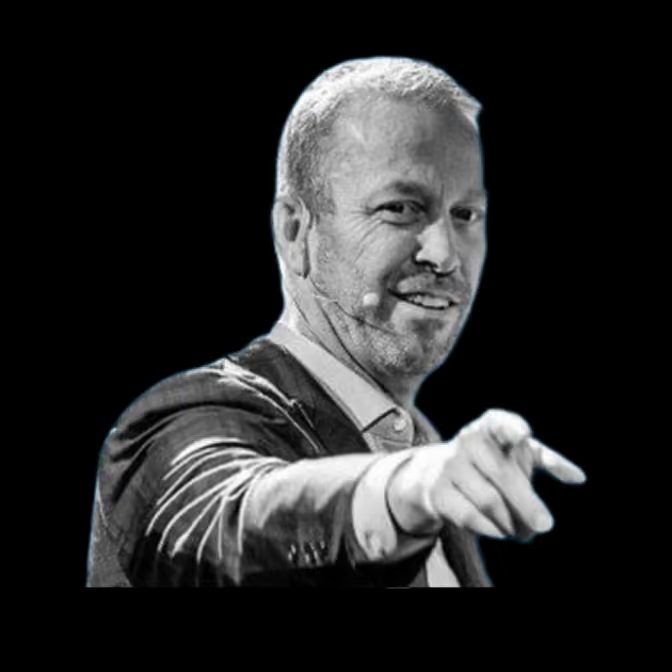
William Harris: Founder & CEO of Elumynt
In this episode of Retain Grow Thrive, Joe Fox, President at Growave, is joined by William Harris, CEO and Founder of Elumynt, a Minneapolis-based (Stillwater, MN) performance marketing agency. William shares how Elumynt was built by accident from in-house growth work, why focusing on **EBITDA—not just ROAS or GMV—**is the key to sustainable eCommerce success, and how agency culture, financial discipline, and strategic paranoia help Shopify brands stay competitive in an increasingly AI-driven landscape.
- Why EBITDA is a more accurate success metric than ROAS or GMV for Shopify brands
- How Elumynt differentiates itself by aligning marketing decisions directly with profitability
- The hidden danger of “good” ROAS when product margins are ignored
- How agency culture, unlimited PTO, and incentive structures drive better client outcomes
- How founders can stay profitable amid AI disruption, tariffs, and rapid ecosystem change


Retain. Grow. Thrive. Season Three
Joe Fox (00:03.305)
Hey everyone, thank you so much for tuning into another episode of retain growth, thrive the grow wave podcast. I'm your host Joe Fox president at grow wave. Today I'm joined by William Harris, the CEO and founder of element element is a really, really cool agency. They're based out of Minneapolis and Minneapolis. I'm correct in saying that William.
William Harris (00:24.718)
That's the closest enough big city there. It's still Water Minnesota, but a half an hour outside of the cities.
Joe Fox (00:27.719)
Okay, so and, you know, beautiful place up there. Everyone I know from from up there is always super friendly. Williams no exception to that. He's got a really, really cool career and really, really cool story of how they started elements and a lot of cool success stories that we're going to hear about today. So without further ado, welcome to the show, Willem, thanks for coming on.
William Harris (00:52.43)
Yeah, thanks, Joe, excited to be here.
Joe Fox (00:54.918)
Absolutely. So I want to kind of dive straight into, you know, element. know, you know, Dilley is an amazing character. I've known him for quite some time and you've built a really cool team there. know you guys do some incredible work. So I'd love to just kind of understand, you know, what was the progression to start element? What is the main focal point? What do you guys do different than other agencies?
William Harris (01:06.894)
Thanks.
William Harris (01:19.438)
Yeah. I'll take you back a little ways. One of the things that I liked the most about just entrepreneurship in general, and probably what we do is seeing the problems that you don't know are there and doing something about it. Right. And so when I started this, wasn't like I worked in an agency before and said, oh, I need to disrupt the agency world or anything like that. I was working in-house at a SaaS company, did a lot of really great growth for them, took them, you know, 270 % in seven months.
I did this for an e-commerce company and I think we went from about like 3000 SKUs to 70,000 SKUs. We got up to eight figures and it was writing about what I was doing on entrepreneur and fast company. And basically other people would come and say, I like what you're doing. Can you help me grow my business too? And I was like, sure, why not? So it started off maybe let's just say as like a side consultancy. But then I started kind of realizing, I was like, man.
Joe Fox (01:48.839)
Nice.
William Harris (02:13.794)
There's a lot of need for people who are able to grow a business that don't just think about the growth side of things, but actually think about the P &L as well. And so you'll see that a lot of times if you're on the marketing team, you don't even know what the P &L is. You have no clue if any of this is doing any good to the bottom line. And so it was just this idea of it's like, okay, merging these things together. Well, I guess we're starting an agency and then it's like, well, then I like to help people and I could only help so many people myself. And I was like, well,
Joe Fox (02:28.348)
Yes.
William Harris (02:42.67)
I can help people who I know people who can help people. It's like, I bring those people on and make this team. so we turn this into a team. And so it happened by accident, but it was just all that idea of seeing this problem. And again, going back to this problem of EBITDA. And so our biggest thing that differentiates us from a lot of other agencies out there is we're focused on if what we're doing is actually improving your EBITDA, your bottom line. And I think that's the hard part.
Joe Fox (03:06.204)
I love that.
Yeah, absolutely. And I mean, I think that's a very unique approach because a lot of agencies are obviously, you know, some are focused on ROAS, some are focused on GMV, some are focused on profit, but to really get in the weeds and focus on EBITDA is so underrated because that's the most important metric in business. It doesn't matter what business you're in. So I really, really love that. And I think another area where, you know, you excel is, is,
clearly on building team culture. Like I've heard from Dillie and myself that you guys have an amazing culture. You've obviously, you know, built a team, as you said, of people that like to help people. So can you tell me a little bit more about how you foster that culture?
William Harris (03:53.516)
Yeah. That's probably the thing that I'm the most proud of now. Right? So like at first I was a strategist and then eventually you become a CEO and you're like, like there's a whole different game here. We've won the Inc best workplaces now two years in a row. And that was better than winning the Inc, getting on the Inc 5000. Right? Because when you think about what it takes to build a team,
Joe Fox (03:57.488)
Yeah.
Joe Fox (04:08.177)
Nice.
William Harris (04:17.262)
And I've read obviously a lot of books and I've tried to study this and I actually just had lunch with a good friend of mine yesterday, Dave Mortenson, who founded Anytime Fitness. And he wrote a book called, I forget the name, I think it's called Love Work, but he talks about like the four P's, you're right. like, but people is at the top of that, right? So it's like profits, sure. Products, People, if you don't have the people who love to be there, if they don't love the work that they're doing,
They can't do the best work for your clients. Your clients aren't going to necessarily feel that love. And so it's just even like cookies. It's like, well, it's a secret ingredient. I made them with love. Like there is something to this. And so in order for your people to do the best work they can for your clients and your clients to feel that your client, your, your people have to feel that from you as a leader. And so I've still got a lot to learn, but the things that I think about when I'm building this team is one hiring for culture, because you can't bring on the wrong people. So you got to know what is it that who
Joe Fox (04:54.908)
Yeah.
William Harris (05:13.984)
Who are you bringing on? And we did go through EOS and we put together what is our mission? What are our values? We narrowed it down to three, because I think you just, if you have 10 or seven or whatever, how do you know that those are actually going to be? It's too many. three, what are the three that I'm like, these are non-negotiables. You got to have these things higher for that. But then thinking about the human condition, what do people want? They want two main things. They basically want agency over their time.
Joe Fox (05:24.464)
Yes, it's too many. Yeah. Yeah.
William Harris (05:40.46)
And let's just say agency over their future. Right. And so over their time, this idea of, we do have unlimited PTO and I know that that can get a bad rep, but if it's done right, it's a very, very, very good thing because now if you want to take an extra day off here, an extra day off there, whatever this needs to be, as long as you've got people who can cover it for you, then you're in a good spot. Go ahead and take that weekend camping trip or whatever that is versus being like, I don't want to waste one of my days on that. So no, no, no, we made it set way you can. We had a girl who went to,
Joe Fox (05:51.483)
Yes.
William Harris (06:09.39)
the, uh, I'm terrible with soccer, whatever the big Stanley, that's not the Stanley, like whatever the big cup is world cup, right? World cup. you go. Yeah. Yeah. So she went to, she went to the, to the world cup or whatever. It's like in Australia, you know, five weeks. It's like, we had the ability for that to be able to be a reality. And so that's a really cool thing. It was a dream of hers for forever. Right. So there's those things, but then over agency, over your finances and over your future as well. Um, one of the big things there is we have an unlimited cap.
Joe Fox (06:16.763)
Free for World Cup. Yep. Yep.
William Harris (06:36.462)
to the bonus and it's based on how much money you're managing. And we think about this very much like you, whether you're CPA or your lawyer or other things like this, where it's based on, you you want the absolute best people in this. I don't want somebody who just simply says, well, I want to go to become manager, director, VP. What if I want the best strategist on our team to continue being a strategist 10 years, 20 years later, but they are just the best strategist and they're working on the biggest and best accounts.
That's what customers want as well. And so if you can find a way to reward those people for just doing absolute amazing work, and that's now somewhat in their control, how much a budget can they manage based on the clients that they retain, the clients that they bring on, et cetera, it gives them that flexibility and freedom to be able to do that.
Joe Fox (07:21.241)
I love that William. There's so many amazing points there that I, that I definitely want to dig into. really, really like the premise that you mentioned around having, you know, the four P's I think it's people, process, product, and something else. I Purpose. That's it. Yes. And the thing I really like about that is, and you know, you hear this a lot in different translations and variations in business books, but
William Harris (07:37.954)
Purpose. Yeah.
Joe Fox (07:48.557)
One that stood out for me and something that I've always tried to do when, you know, in leadership positions and building teams and everything is having the right people on the bus. it's that Jim Collins built to last kind of theory. And it's so important. And you're so right. And I think, you know, you've clearly implemented that within the business. I love, absolutely love the management financial strategy. That's such a really cool.
way of doing things. I haven't heard of anyone doing that until just now, but it's a really, really, really good concept. Congratulations on figuring that out because obviously that works well with the culture. That's very cool.
William Harris (08:26.68)
can't take credit for that. I gotta give credit to my business partner, Jeff Snyder. He's the one who figured that out. So shout out to Jeff on that.
Joe Fox (08:32.84)
Awesome. Awesome. Well, thank you, Jeff. I haven't met Jeff, but yeah, that's, that's really cool. And William, so obviously, you know, you've, you've spoken on a few things here. I'm going to go off topic a little bit because I really love to dig into, know, how founders think. And you've clearly got a very good grasp of all of this. It sounds to me like you've got a very good supportive network of other, you know, entrepreneurs, mentors, et cetera, like that. How did you
find that path. How have you kind of gone about seeking out strong mentors? And then, you know, it's one thing to have a mentor, but the second thing is actually implementing that advice and that knowledge and wisdom.
William Harris (09:14.062)
That's true. That's so good. I actually wrote about one of them on, I want to say it was entrepreneur years ago. it was, I wrote about the one with Dave Mortenson. His daughter was on a volleyball team that my wife was coaching at the time. I think she was in like seventh grade. And so he's in the stands. And so I talked to him a little bit or whatever. And it's like, man, like this guy is brilliant. I want to get to know him more.
Joe Fox (09:32.408)
Okay.
William Harris (09:40.502)
And he was on this show called, I was thinking it was like millionaire boss or whatever, like something like that. Does that sound familiar? What was it like undercover boss? Yeah. Thank you. Undercover boss. And so like they have to go undercover and as a result of that, you know, they have like $50 a week for groceries kind of thing, like, cause they're undercover. They're like doing this for real. and I think if I remember correctly in the show, he, he was like, I can't skimp on the mayonnaise. I gotta get the mayonnaise kind of thing. It was a funny thing.
Joe Fox (09:47.01)
I'm undercover boss or is it something like that? Yes, yes, yep.
Joe Fox (10:06.586)
Ha
William Harris (10:07.852)
So when I met with him the first time, I brought in a jar of mayonnaise. and it's like a gift. It's like, what am I supposed to give this guy? Right. That's like a thank you for meeting with me. it's like, and it's like one of those things that kind of stuck, but anyway, so we've, we've gotten together and we've just, I would say the simplest thing was just ask, right? Like find somebody that impresses you and just ask. They may not be willing to, but they may know somebody else who is willing to write this. Hey, I'm busy right now, but I think that somebody else would be really good for you.
Joe Fox (10:11.595)
classic.
Yeah.
Joe Fox (10:30.735)
Certainly.
William Harris (10:35.272)
and that's really how it's kind of started. And so there's a, yeah, a network of mentors that I have for different aspects of what I'm doing, whether it's business, whether it's personal life, whether it's spiritual life, whether it's, you know, physical health, there's different people that I'm talking to, to say like, how do I, you know, absorb as much of this knowledge? And I love that you caught out though, that it's like, it's one thing to ask somebody for advice. It's another thing to actually implement that advice. and that's one of the things that Dave and I talked about yesterday was,
A lot of people have ideas. A lot of people have insights. A lot of people have wisdom, but doing is still probably the most important aspect of that. And the reality is you might not implement it correctly, but you got to start. And if you implement at least anything, then you can course correct. But if you implement nothing, you have no clue if that's still even the right idea or not. You just have a good idea. Maybe, but you don't know.
Joe Fox (11:10.776)
Yes.
Joe Fox (11:26.507)
Absolutely. Yeah. I really think that's what separates, I guess everyone from entrepreneurs and from business people, right? Is the doing because there are a lot of smart people out there. There are a lot of people with fantastic ideas, but unfortunately they never see the light of day because there's no execution in place. And I think you're so right about being able to course correct once you begin, but you have to begin. Like you can iterate once you've launched something.
You can get an MVP out there, but if you don't have that at all and you don't start moving, it's just going to be, you know, an idea. There's like a saying it's like the graveyard of ideas is huge. So I couldn't agree more. that's really cool and very, very like purposeful in the way that you've actioned that into your business, into these different silos and individual aspects of your life. So I really liked that. I am a.
big believer of like being around the right people for whatever it is that you're doing. so, and you know, sometimes being the, being the dumbest person in the room about a particular subject can be very useful. can be intimidating, but it's very useful for, for growth. Um, okay, cool. So let's dive in a little bit more. Like we've, we've done a little bit of the business stuff, what makes you, you, and all of these sorts of things. But I really kind of want to dive more into this e-comm ecosystem.
William Harris (12:27.821)
Yeah.
Joe Fox (12:53.602)
the Shopify ecosystem that we're all a part of. Obviously, Element, you guys are working with some pretty amazing brands. Tell me more about, you've told us about the culture of the business. What's the, you don't have to give away the secret sauce, but what are some of the key differential things that you're doing when you're focused on EBITDA and you're working with a merchant who has an e-comm store, let's say they're doing four to five million in GMV.
Obviously they might have varying levels of EBITDA, but what are the main things that you're kind of diving into and the teams diving into?
William Harris (13:30.19)
Yeah, that's a good question. At a high level, the biggest thing that's different is actually just looking at it in the first place. If you're not even looking at EBITDA, if you're not looking at whether or not what you're doing drives it up, and I'll give a good example of this. There's maybe two examples of this. One is if you have a product, let's say that's $200 and another product that's $100. Let's say on the $200 one, I hope I don't lose anybody on my math here. $200 product.
Let's say that you have margin of $50 on that one. In the $100 one, you have a margin of $75 on it. So you've got much better cogs on that one, right? Let's say that you've told your marketing agency, hey, I want a $50 CAC across the board, right? Customer acquisition cost. They nail it. They're getting this $50 CAC. On the $200 item, 200 divided by 50, that's a four to one ROAS, return on ad spend. And on the...
Joe Fox (14:24.225)
Yep.
William Harris (14:25.23)
$100, 100 divided by 50, that's a two to one ROAS. But the problem is that on that $200 item, we just said you only had $50 of margin. You gave all of that margin up in your CAC. On the $100 one, you ended up with $25 left over after that $50 CAC. And so the difference is that two to one ROAS was better for the bottom line of your business than that $200 item one was, the four to one ROAS. And so a lot of people, if they're just looking at this and they're just simply saying,
Joe Fox (14:36.428)
Yes.
William Harris (14:53.826)
Four to one is better than two to one scale the heck out of that one. They're missing what's good. And your CFO is saying, we need to do better. And so what the CFO says is maybe we need a five X that maybe we need a six X. And what does the agency do? The agency says, well, I got to pull back on this campaign and I got to pull back over here. I'm going to spend less on this prospecting. That's getting a two to one because we got to go higher. They end up not even spending enough now to cover your, you know, op ex or whatever that might be. And so.
You end up in this very dangerous cycle by not actually understanding the nuance of even the way that your products are increasing or decreasing your profitability.
Joe Fox (15:29.664)
I love that. That's so cool. You broke that down incredibly well, by the way. I don't think anyone would have lost you on the math. Yeah, that's, that's spectacular. I mean, I can only imagine, you know, a lot of the audience that are, that are watching or a lot of our customers and a lot of our customers and brands, you know, they're working with an agency or they're doing this themselves. So I think, you know, I reiterate this in a lot of the podcasts. It's so important to have experts on your side.
like William, like his team at Element, because if you don't, these are the traps you fall into, because it's very easy for someone to focus on these numbers and see these numbers and think, this is amazing. And then it doesn't reflect that in your profitability. So that's very important. I love that. And what do you think, you know, just in terms of like, obviously there's a lot of stuff going on, like,
William Harris (16:07.234)
Very easy.
Joe Fox (16:26.143)
just across the border, a little bit further north from you, we've had this, another change in tariffs and tariffs are kind of, you know, changing almost every day. And there's all sorts of things happening, you know, on the AI front, everything that's just been launched with lovable, chap GPT, you know, and Shopify now having this integration where you can shop through chap GPT. And it's just changing at such a pace. I mean, there's always been change in this ecosystem.
But the pace now, it seems like it's nothing that's ever, it's not comparable to anything that has been before because there's so much change happening so quickly. How are you, William, looking at that from a, you know, there's obviously a lot of opportunities to increase, you know, EBITDA for brands utilizing that. But then for some brands, the strategy is probably seems a little bit overwhelming, I would imagine. So what are the kind of
things that you're implementing or your team's implementing for merchants to kind of look at this from a long-term perspective and weather some of the storm, so to speak.
William Harris (17:33.294)
I had somebody on my podcast actually named Alan Gregerman and he wrote a book called The Wisdom of Ignorance. And he talks about this need of staying paranoid a little bit as a founder, as a business owner. And I appreciate it because someone, something is always looking to take your lunch. so it's tariffs, it was COVID before that, it's something else. There's always something.
Joe Fox (17:52.265)
Yes.
William Harris (17:58.754)
that is going to try and completely disrupt everything that you're doing. And if it's not these big global things, it's more smaller things within you. It's, the wrong hire. It is, you know, a product failure. It is a manufacturing error. is a shipping logistics thing. Like there's always something. And so part of a business owner's goal is you need to be nimble enough to know where you can make changes and be ready to make those changes. And if you're not looking for that, if you're not a little bit paranoid, you're going to miss it.
and so think that's the first part. The first part is just being paranoid enough to be watching for those things. The second part is you've got to stay in the game, right? And this is something that I think a lot of other people have said well before me, I don't know who to attribute it to, but the only way you lose is if you're out of the game. If you stay in the game for the most part, this is true. Not just in business is true and investing in a lot of times, right? If let's even go back to 1929, right? Like black Friday or whatever, not black Friday. What's it called?
Even then, if you would have been able to keep your money in the market, for instance, it's like you end up on the other side in a better position. so if you can stay in the game, you're good. The way to stay in the game is to at least have some good financial practices in place where it means, and it's so exciting to want to go as aggressive as you possibly can. And I would say that I'm not going to tell people not to be as aggressive as they can. We like the red line businesses a lot as well.
What's the maximum cack that you can afford? Great. Let's run right to that line. I'm not against that, but you have to know when you need to pull back a little bit, when you need to be a little bit aware of what's going on, because if it completely takes you out of the game, it wipes you out. can't recover from that. So you have to be aware of that. At least there are lots of stories that you'll hear of people who went and just said, you know, through caution of the wind and said, doesn't matter. I'm going to go all in. And the reality is that will work.
a fraction of people, but there are equally as many, if not way more stories of those same people who threw caution to the wind and it backfired on them and they're out of the game and that's a lot harder to recover from. So I think there's some wisdom just being paranoid and then figuring out how you can make sure that you're in a good place to stay in the game.
Joe Fox (20:09.259)
Absolutely. Yeah, I love that. I think that's such a good, good frame and a good way to analyze things. you know, I really, it's something I really admire about our CEO, Eldar and our founder is he has this very healthy level of paranoia and it's good because him and I kind of tend to balance each other out. Whereas I'm usually the red line, go for the swing for the fences. Let's go. He has that sometimes conservative, you know, kind of level of paranoia.
But when we meet in the middle is where we get the best results. So yeah, I really liked that. It's a good, good way. I'll have to mention to him that we discussed this and I gave him that shout out. But, William, one thing I love to do on this and, know, I certainly would love to do a part two of this. I think, there's so many exciting things coming up in the calendar in terms of, you know, we're just around the corner from BFCM. That's going to be very interesting. Be super interesting to see.
You know what open AI is, is the direction they're moving in and some of the results that they're having with Shopify will be out early next year. There's just a lot happening in the ecosystem. Um, so I definitely want to dive in for a part two of this at some point. Um, and obviously once our partnership blossoms, I'd love to be able to tell some success stories about that. Um, but one thing I love to do on the show, William is obviously, you know, everyone in business travels quite a lot.
Every industry travels quite a lot, but I feel in this e-comm ecosystem, we probably are some of the people who travel the most. And what I love to do is kind of always ask every guest and you can't say a person, what is the one thing that you cannot travel without?
William Harris (21:54.028)
Hmm. I can't travel without, can't say a person. I mean, it's such a dumb thing. Like I would say my iPhone, but I almost need to come up with a better answer than that. Right? Like that's almost a given now at this point in time. So let me come up with something other than that. But it's like, well, I need that. It's like, I need that for the Uber. I need that for everything else. We're checking in. what's something that I can't travel without besides that though? Hmm.
Man, I like this question.
Joe Fox (22:23.398)
give you, I'll give you mine is always a book, like there. It's a book and it's a battery pack to support the iPhone. But I always have to travel with a physical book. I find for me, it gives me something to kind of like center on and ground on. And it's kind of weirdly meditative for me when I'm on a plane, because it allows me to just kind of, I'm not someone who works on planes. I know a lot of people like love that, because they can jump in and do that. I utilize the time to think and to read.
And so the reading kind of triggers my creative thinking. So that's my one.
William Harris (22:56.77)
Hmm. I love that. You know, I mean, I wish I had a better answer. I would say that I pack minimally almost for any trip that I possibly can. It's my backpack with my laptop. It's my charger. It's, whatever clothes I can fit in the backpack rolled up into a ball. and my phone, like I want to go as minimally. I don't, I don't really pack a whole lot other than I guess underwear, right? I got to bring my underwear and I got to bring my phone. Like those are the things that I absolutely have to have.
Joe Fox (23:19.879)
love that. Yeah. Yeah. Yeah. Yeah, I love that. I think it's so cool to be a minimalist in terms of travel. mean, unfortunately, my wife is the opposite to that. I know this because you know, when we visit places like Paris, I'm lugging these gigantic suitcases up these old rickety wooden stairs that don't have elevators, etc. in the building. So
William Harris (23:39.255)
Ha ha ha.
William Harris (23:44.683)
Yep.
Joe Fox (23:46.193)
Yeah, I'll have to I'll have to make sure my wife sees this one. Awesome. Awesome. Well, William, look, thank you so much for coming on board today. I really, really valued these insights. I mean, there's some incredible business insights in here for fellow agency owners. There's some incredible insights in here for customers of GrowWave and an e-commerce brand to potentially looking at the wrong figures and the wrong numbers and pushing the wrong motions.
William Harris (23:50.743)
Yeah.
Joe Fox (24:16.04)
William, where can people connect with you? What is the best place to get in touch with you if there's a brand that would love to work with Element and really focus on this methodology that you're implementing by working with you? Where can they get in touch with you?
William Harris (24:32.046)
Yeah. If you want to follow me because you enjoy listening to me speak or whatever, you want to learn more from me, probably the best place is either going to be on LinkedIn or X. And it's just at William Harris 101, but it's the abbreviation WMHARRIS101. If you want to work with us though, you're a brand or customer, the best place is going to be to go to our website, is element.com. E-L-U-M-Y-N-T.com.
there, fill out the form. That's the best way to get in touch with us. If you send me DMs, there's so many DMs in so many different places. I'm not the best at it. I'll tell you right now. Send it through the website and it will make sure that it gets to me.
Joe Fox (25:08.455)
Absolutely. And I'll make sure all of those links are included in the show notes audience. So don't worry about trying to remember what was just said. All of the links are below for you. William, thank you so much for coming on board. Like I said, I'd love to do a part two of this. I really, really appreciate the partnership we have. I love that Dilly is on the team. think that is a perfect summary of...
William Harris (25:29.518)
Still, yes, amazing.
Joe Fox (25:34.807)
talking about people fit and culture and everything. You know, he's just a wonderful human being. So I'm glad that he's on your team and he absolutely loves it. And I'm glad we're getting to partner. So yeah, super excited about what the future holds. And yeah, thank you for coming on board. I appreciate it.
William Harris (25:36.663)
Yes.
William Harris (25:40.437)
Absolutely.
William Harris (25:51.714)
Yeah, thank you, Joe. Really had a good time here with you. And thank you, Dilyar. We love you. You're amazing, too.
Joe Fox (25:57.101)
Absolutely. Audience, thank you so much for tuning into this episode of Retain Growth Drive with William Harris of Element. I'll make sure every single one of the links that we have mentioned is included in the show notes. I highly encourage you to check out Element. That approach of really focusing on EBITR and profitability, as opposed to just looking at things like return on ad spend and CAC, et cetera, et cetera, are very important metrics.
so they do things a little bit different, but it really works. And I know that because I've seen the success of the brains they work with. So please, please, please, please. I encourage you to reach out to them and check them out. But thank you so much for tuning into another episode. If there's any guests that you'd like to see us have on the show, please comment below wherever you get your podcasts. Thank you for listening. We appreciate your support and thank you for tuning into another episode of retain growth thrive.



.svg)