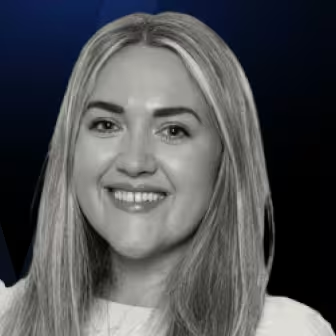
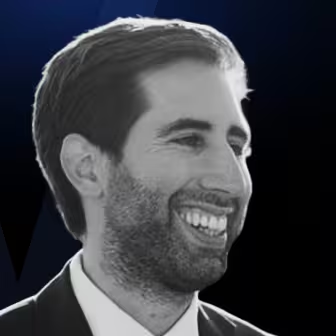
Daniel Brady: Co-CEO at Orita.ai
In this episode of Retain, Growth, Thrive, Growave President Joe Fox sits down with Daniel Brady — CEO and co-founder of Orita, former Harvard-trained neuroscientist, and machine learning engineer — to explore the intersection of data, AI, and modern retention marketing. Daniel shares how his background in developmental neuroscience shaped his approach to building high-speed, high-impact ML systems, why audience targeting is the most powerful (and under-optimized) lever in retention, and how Orita is transforming how brands like Spanx and Tracksmith unlock revenue through real-time AI-driven segmentation. The conversation dives into the future of AI in the Shopify ecosystem, the coming balance between personalization and universal brand messaging, and even Daniel’s life as an avid East Coast surfer.


Retain. Grow. Thrive. Season Two
Joe Fox (00:02.863)
Hey everyone, thank you so much for tuning into another episode of retain, grow, thrive the Growave podcast. I'm your host and president at Growave Joe Fox. Today I'm joined by someone that I personally admire in this industry has an incredible history. As you can tell from the background in their image, they're likely an avid surfer, which we're going to dig into as well. But Daniel Brady is the is the CEO, co-founder of Orita has a super interesting background.
Daniel Brady (00:21.038)
Yes, absolutely.
Joe Fox (00:32.475)
highly educated graduate from Harvard, and also previously in a previous life, neuroscientist and ML engineer. So there's tons of really, really cool stuff that we're going to dive into today. So, DB, thank you for coming on board today. And thanks for being on the podcast.
Daniel Brady (00:52.718)
Thanks so much for having me, Joe. Happy to get into it. Let's do it.
Joe Fox (00:55.297)
Absolutely. So, can you just give everyone a little bit of a background? mean, not everyone that comes on the, on the show is, is an ML engineer or a neuroscientist. So I'd love to kind of dive into that and how that's translated into, you, you co-founding Orita.
Daniel Brady (01:04.878)
Yeah. Yeah.
Daniel Brady (01:10.431)
Sure.
Yeah, you so I used to be a neuroscientist. you know, did my undergrad, did my PhD, and did my postdoc. So I was like on the track to be a research scientist studying neuroscience and I studied developmental neuroscientists. like how do brain early life experience, how does that shape the way in which your brain processes information for the rest of time? And what it really was about was I was studying learning. Like that's fundamentally what it was that I was studying.
and at that same time of like doing all this neuroscience, there was this rise in machine learning, but not just like machine learning generally, which has always been around, but to actually be able to use it outside of an academic context. And so when I decided to leave academia, I left because to me, academia was like really, really slow. It was like my, it's not even a joke. It's like, true. I found what my PhD thesis was on in my second year. And then I spent another four years proving that that was true over and over and over and over again.
Joe Fox (02:06.596)
Wow. Wow.
Daniel Brady (02:08.782)
And so I left academia and my friend was the CTO at a same day delivery startup. This is in 2013 when every other company startup was like a same day delivery startup. And I did, I did a little bit of math for them and to help optimize their routing using basic stuff that I was doing all the time as a neuroscientist. And they're just like, okay, you're our first employee. And, and so that, that then I then got addicted to like the speed and the, the watching like
Joe Fox (02:19.8)
Yes.
Joe Fox (02:30.573)
Wow.
Daniel Brady (02:37.218)
you do this little change and all of sudden thousands of orders are being rerouted according to like something that you designed mathematically. And so I got addicted to that. And so I've been in tech ever since.
Joe Fox (02:46.394)
That's really, really cool, DB. And I'd love for you to tell, tell a little bit more about that speed because I think that really translates into, into what you're doing at Orita like incredibly well. mean, I'm obviously really good friends with Dai on the team and, and Megan and everything. And I really feel that that that's something that you guys are all very much about. It's like speed of execution and doing things properly. So.
Can you drive in a little bit more around how that translates?
Daniel Brady (03:15.19)
Yeah, sure. know, so like there, think speed and then just trying to take advantage of as much information as possible in order to make a really informed decision. Those are like the two guiding principles that we have. And so like when, when Zach is my other co-founders also machine learning engineer, when we first started Orita, you know, we were like, there's so much information that is being collected about what people are doing and how they're interacting with brands. yet, you know, at any given time,
whether it's a marketer or even an ops person, if they're doing routers like that, they're only looking at like a very, very narrow piece of that pie. And they have, they're slow to react, right? Like you're human. like you can only, you can only take so much information at one time. And so we're just like, well, machine learning models can be extremely reactive. They can also look at so much more of a breadth of data. And so perhaps those things combined in the context of marketing can like really level up how well you can target people because they're just like,
Joe Fox (03:51.341)
Yes.
Daniel Brady (04:09.686)
It's so much faster and there's so much more breath that you can take advantage of there.
Joe Fox (04:13.645)
Absolutely. And I think it's so prevalent, like to your point, there is so much data available. There are so many, you know, machine learning and AI technologies available that allow businesses to really like power that and use that for business intelligence, as opposed to just looking at it, having an opinion and actually not crunching that data. So I think that's really cool. In a previous life, I owned an agency and then I moved over and worked.
for a machine learning company based out of Norway. This is quite some time back a few years before COVID started. And I really loved the sort of like cutting edge stuff they were doing with machine learning. And they did a whole bunch of stuff with the University of Oslo. So I can kind of relate to you a little bit about that translating out of academia and then translating that into business intelligence. That was a really cool company to work for. DB, what's...
What's the biggest, I guess, kind of focal point for a reader? Like, obviously you're doing a lot in terms of like data and actionable data and everything for brands. And I know you have an incredible partnership with Klaviyo, which we value too. So can you tell us a little bit about how all of that kind of works?
Daniel Brady (05:14.52)
Yeah.
Daniel Brady (05:23.555)
Yeah.
Daniel Brady (05:29.902)
Yeah, I think, I think the way that I think like to think about it is, and this is the way that Zach and I designed it when we first started, just to like take a step back and be like, what is the most impactful thing that you can do as a marketer? And the first thing that you can do is determine who is the audience at any given moment in time to market to. And that's like first principles. so like Zach and I weren't marketers, but we're just like, well, what matters is who's who are you going to outreach to right now? And then after that, you make that decision.
then it comes down to the content and the offer and the branding and all that kind of stuff. But that first part of the audience part is the most important. And it's really interesting because like we live in this gen AI world where like everything's about messages and offering and like that's super, super important. Like, you know, to have a conversion rate go from 1 % to 1.5 % is a big deal. But when we took a step back, we're just like, when have you changed your addressable audience from like 40 % of your CRM list to 60 %? Like that is like a much, much bigger.
pace. And so that's exactly where we sit. So what we do is we do AI customer segmentation. And it's really all about like the timing. So it's all about the targeting and the who on that list. And then our brands or agency partners. And you know, even now with Klaviyo, they have some new agentic stuff, like they focus more on the messaging. But ours is really like, if you give us your list by channel, we will tell you what is the maximum addressable audience at any given time. Here's who you can email right now. Here's who you can text. Here's you can send a postcard with postpilot.
Joe Fox (06:27.903)
Absolutely. Yeah.
Daniel Brady (06:56.726)
And like there's no, there's like, that's the maximum amount of revenue that you can give at any time. And it like waxes and wanes depending upon how the consumers are interacting with you, the time of year, all that kind of stuff. And then you can focus in, then you can therefore focus more on like the offer and the messaging yourself.
Joe Fox (07:11.692)
love that DB. And I think it's really cool because, you know, I think as a business, like if we, if we take out, you know, SAS and our tech lens off and all of those sorts of things, you know, as a business, providing, you know, a product to consumers, it's like the thing I really like about a reader is that not only are you helping them, you know, essentially generate more revenue, but you're also saving them a lot of money because I think that's one thing that, that, you know, is really
important to address here is because you're cleaning up that addressable market and identifying who is actually a proper, you know, ICP of those brands that I imagine would significantly reduce the costs of your SMS counts, your email counts and your subscription costs.
Daniel Brady (07:59.544)
Totally. And so, you know, every channel has a cost. And for channels like SMS or for direct mail, the most expensive part of it is actually the cost itself. Postcards are not cheap to send. For email, know, sending emails are cheap, but, you know, the ultimate deciders of whether or your emails get seen are the inbox providers. And so the cost in the email sense is this concept called deliverability, which is like, if you just spam your list, no one will ever see any of your messages.
And so there's always this kind of like balance of targeting of like there's a cost and a benefit to any sign that you send on any channel. And like it's trying to figure out exactly that kind of optimal mix. And so that's what we do is like by per channel, we figure out what is that optimal mix. And it's either sometimes it's optimizing for revenue versus costs. Sometimes it's revenue versus deliverability, whatever it is, but like that's the whole goal.
Joe Fox (08:29.567)
Yes.
Joe Fox (08:53.099)
love that. and, you know, I feel like a reader has grown so quick, like that, that like, out of I'm very plugged into the kind of like partnership ecosystem having recently gone from, you know, specifically partnerships into more of this presidential kind of like leadership role, but I know how quickly you guys are growing. I know how well respected you are in the ecosystem by agency and tech partners alike.
So I'd love to just kind of shine a little bit of a light around what you believe is fueling that growth so quickly, because we have a lot of, you know, I get a lot of really young, you know, kind of founders here that are having, you know, incredible success within their first kind of like six to 12 months. But then there's also a lot of kind of like legacy, you know, platforms that may have stagnated in growth. So I think it'd be really cool.
Daniel Brady (09:30.221)
Yeah.
Daniel Brady (09:42.136)
Mm-hmm.
Joe Fox (09:50.528)
for both sides of that equation to hear what's driving a lot of your growth.
Daniel Brady (09:55.276)
Yeah, I think, I think what's really, really important here is to really understand who is your customer base, right? So who's, who's that ICP that you really care about and how can you best serve them? And so, you know, we're a machine learning company, so brands that have more and more data, we can opt and have more and more history of marketing we can be very effective for. like, you know, whether it's like Spanx or Everive or Tracksmith, like that, like you can deliver a lot of value because their list has so much variability. And so there's so much
There's so much data that needs to be used in order to maximize that list, but we're also extremely partner centric. So a lot of, a lot of the brands come through us actually through their agency partners that they use, their retention agencies or the dev agencies that they're using. And the thing is that like, we're really focused on like an extremely difficult problem that basically everyone has agreed that machine learning is better than humans at, which is like this, more precise targeting, but it's also doesn't step on anybody's toes. It's just like.
you know, as an as a person who's run an agency as as a CRM manager, you know, you're using these recency segments, who's clicked in the last 90 days to determine your targeting and you know, that's not the right answer. But it's just like you have so many other things that you need to focus on that like it kind of gets left in the dust and you're just like, I understand that I'm not optimal here, I'm losing but I need to like, come up with a creative for my next sale, I need to work with merchandising on this side of the other. And so we're just like, hey, keep doing all of that really, really important work. That's, that's also so critical.
We're just the machine learning nerds on the side here who will take care of that like really naughty problem and make sure that it's optimized all the time. Make sure that we're constantly testing. And that just really resonated with both our brands and our agencies that like, this is the long, this is a long standing problem. This is not a new problem. It's actually one of the oldest problems that's out there. It's not very sexy, but if you put like the most cutting edge machine learning and math towards a not sexy problem, what actually delivers a ton of value. And that's ultimately what they all say.
Joe Fox (11:48.649)
love that. Yeah. And it all makes so much sense. I think it's fascinating talking with you because I can kind of like understand a very small snippet, you know, talking back of the way understanding the way the brain thinks and everything like that. I can certainly see that. So that's super impressive. Cool. So another thing that I really love to kind of, you know, just dive into, I love getting everyone's insights on what they feel is happening in the ecosystem. And I think
DB, you're perfectly positioned with your background in machine learning and AI to really give some cool insights here. So obviously, there's all sorts of things happening in the Shopify ecosystem being driven by AI. This integration between Shopify and OpenAI and ChatGPT and the list goes on and on. Things like lovable that were reduced.
and that's their kind of thing the other day, obviously that's going to impact agencies. But in general, I would love to just kind of get, you know, even if we were just to say, what are your 12 months predictions around what we're going to see as we move further and further as an ecosystem and lean further into AI.
Daniel Brady (12:57.774)
Yeah.
Daniel Brady (13:04.994)
Yeah, I think it's really interesting. And I have some strong opinions here, some of which, I don't know if they're necessarily controversial, but they're slightly different. So just because I know a lot of them that is under the hood here is that there's this big obsession with the road to extremely personalized marketing, on a per person basis that things are personalized. My view is that it's actually going to be a balanced mix. So that's not that controversial. It's just like, there are things that a brand will want to say that
is a standardized message. The way that I always talk about it is that Super Bowls are not personalized. Super Bowl ads are not personalized. And they're so extraordinarily effective and it's something that generates cultural conversation. Coca-Cola's logo is not personalized. It's like you see that on a billboard, you're thirsty, you get a Coca-Cola. And so what I actually think is going to be the future in the next 12 months is really about the balance of those sorts of things. if we think about it in terms of now going more into marketing, campaigns versus flows, I think that that's kind of where you'll see this big divergence where
Joe Fox (13:40.616)
Yes. Yeah.
Daniel Brady (14:04.972)
a lot of what are considered campaigns, it's like, how can you get these big effective messages that are not necessarily that personalized, but like, you want to make sure that you can find the right audience in the smartest, most intelligent, most efficient way. think a lot of AI is going to be going in that direction. That's kind of where we sit. And then I say, on the other hand, there's going to be like, okay, but now Mike, now this customer is actually interacting with me at this exact moment. How do I interact with that customer? And I think that's where all like the gen and the agentic stuff like really, really shines. And so
If someone's visiting your website and they want to like have some sort of customer support ticket or asking about about, you know, recommendations of like this pair of, you know, boots versus that one, like that I think is a perfect place for like that kind of personalized interaction. Bounced with the fact that you're just like, we're launching this new product and we want it to see the most number of people possible. And we're not changing what that product is per person. like, how do we like effectively use AI in order to make sure that that is the maximum audience at the time? And like, what is like
Joe Fox (14:51.122)
Yes.
Daniel Brady (15:03.096)
When you reach out a second time or third time or on a different channel? What is that? That marketing mix that really makes it super effective. think like from a marketing perspective, that is like where things will be in the next 12 months. And then what I really hope, I think this will take a little bit longer than 12 months is I want to see like a whole closed loop in terms of the data. Like how does inventory and fraud and all that kind of stuff inform your merchandising decisions, which informs how you acquire customers, which informs how you then retain them.
having that whole closed loop, is like this golden shanger law that like, you know, we've been trying to build for so long. It's like, well, now there's so much data and now there's so much ML, you can have a system where it's like, acquire the customer, market to them, retain them, make decisions based on Merchants ID in the future based on that and have this like huge virtual cycle.
Joe Fox (15:38.42)
Yeah.
Joe Fox (15:51.805)
Yeah, no, I very much love that. I get a lot of people's insights, you know, doing the podcast and having these conversations, but I love that. And I think for me on a selfish level, that's what I'm most excited for is to see what that entire actual picture looks like. I think for the first time in history, we're probably actually going to be as close as we can be at any given time to understand that complete journey.
and I think that's going to be incredibly exciting. And, know, from a grow wave perspective, that's exciting for us on the retention piece, right? It's like being able to really, really fine tune every single one of our features to match what those journeys look like. So that's super exciting. DB, I I'd be admiss to not dive into this and, you know, obviously big surfboard in the background, I believe you grew up on the West coast. Is that correct? Yeah.
Daniel Brady (16:21.902)
Totally.
Daniel Brady (16:49.014)
I did, I did. I grew up in LA and lived in the Bay Area, but now I live in New York City. And so in my New York City apartment, I have four surfboards. So it's like what takes up most of the space on the wall are my surfboards. And I do surf in New York City, which most people don't think you can do, but you can. It's actually a great surf community here. And so yeah, that's like my major passion. Cause I have a family and I'm working a lot. And so if it's not those two things, then it's probably trying to get some surfing.
Joe Fox (16:56.908)
yeah. Yup.
Joe Fox (17:16.474)
I love that. Being from Australia, it's hard to not, you know, kind of surf. You grow up surfing. I'm in Texas now. Fortunately, we don't have any surf here. mean, Galveston is not a place you'd want to go. apparently they've opened up and sorry to diverge. I just find it fascinating. They've opened up one of these wave parks up at Waco. So I'm hoping to go check it out. do you in New York, is there, is it like
Daniel Brady (17:19.532)
Yeah, of course.
Daniel Brady (17:27.031)
no.
Daniel Brady (17:30.574)
haha
Daniel Brady (17:38.648)
Sure. Yeah, I've heard about it, yeah.
Joe Fox (17:46.072)
Are you using the sort of like wave pools or is it, is there actually dedicated cool spots? If it's a secret, you don't have to give it away.
Daniel Brady (17:51.68)
Yeah, no, no, no, it's not. It's not. It's nothing in New York is a secret. It's too big. There are are there is like a wave pool in New Jersey, which I think open, you know, just before the pandemic, which I haven't been to. But New Jersey and all of Long Island, including New York City, has a like a ton of surf. And so, yeah, like the the most famous place to serve in New York is called the Rockways is actually right next to JFK Airport. And so if you would if you were just go the opposite direction as opposed to going to Manhattan, if you just went
Joe Fox (18:16.475)
Okay.
Daniel Brady (18:20.846)
opposite direction, you hit a surf community. And it's like where the, it's where the Ramones are from and stuff like that. So it's like, it has like this like rich history and like, it's really good surfing. And then as you go further and further on to Long Island, like in Montauk and all these like super famous places that it's like, like the East Coast as someone from the West Coast and the East Coast gets so much trash about the quality of surfing because it's so much more storm dependent and it's not, so much less consistent. actually love, I love East Coast surfing. I love surfing in the winter. I love wearing like the thick wetsuit and it's snowing outside. It's awesome.
Joe Fox (18:24.25)
Wow.
Joe Fox (18:43.939)
Yep.
Joe Fox (18:50.885)
I love that, yeah, I was gonna say you'd have to have a very, very, very, very warm wedding to be able to pull that off, I imagine. With the hood and everything, with the hood and everything, yeah, yeah, absolutely. I feel like, you know, the last time I saw that was Tasmania. Like I didn't surf in it, but a couple of friends went out, the hoods, everything like zipped right up and you get some pretty big waves down there.
Daniel Brady (18:56.59)
Yeah. Yes. Yeah, I do. 100%. Oh, yeah. Yeah.
Daniel Brady (19:08.268)
Mmm, cool.
Joe Fox (19:17.796)
If the swells right for sure, if you get like the right conditions, some of those waves are pretty big and pretty scary. Hence me not going out there. I'm good in like, I'm good in like the three to four to maximum sort of six foot stuff. I like the shorter stuff, but I'm and closer to being on shore, but yeah, don't get to do it enough in Texas. That's for sure. But on that note, DB, I always like to understand this from people who are, you know,
Daniel Brady (19:30.402)
Yeah, sure. Yeah. Yeah.
Joe Fox (19:45.987)
obviously highly intelligent, you're obviously really highly, you know, emotionally and intellectually intelligent. Is the surfing for you a way of quieting, you know, talking about the way the brain works? Is that a way for you quieting all of the noise and kind of being present?
Daniel Brady (20:00.3)
Yes. Absolutely. It's like the best way for me to focus. Like I think it's even something where I won't realize how much I needed it until I get out there. And it's just like, there's, mean, you know, you've done it. It's just like, you can't, you can't do anything but focus on where you are and read the waves and all this kind of stuff. Like your mind can't wander.
Joe Fox (20:19.247)
Yes.
Daniel Brady (20:23.854)
Otherwise you're not going to surf, you're just going to be sitting on a board in the water. And so like, it really focuses you to kind of be like very, very present and like that. It's almost like a meditation for me. Really. It's like I go out there and so even if I don't necessarily have a great day, it's in terms of like the rides and stuff like that, it's still always an amazing experience just because it feels so meditative.
Joe Fox (20:27.044)
Yeah, yeah.
Joe Fox (20:34.212)
Yes.
Joe Fox (20:43.866)
Yeah, I love that. I love that. That's awesome. Okay, TB. So I feel like we could chat a long time. There's a lot of shared aligned interests here and I definitely love to do a part two in 12 months and hopefully we're able to talk about that, you know, golden circular journey and what that looks like and what tools are helping to fuel all that. But one question that I also love to jump in here, I know I see
Daniel Brady (20:50.51)
This was great.
Daniel Brady (21:01.336)
Yeah.
Joe Fox (21:09.082)
You know, Diana and Megan, almost every event that's there, they really, you know, get out there and as I'm sure you do, and I feel like in our vertical and in our industry specifically, we're probably some of the most avid travelers, like in terms of the volume and the mileage and all of those sorts of things. So I'd love to get this last piece of thinking and advice from everyone who's on the show. And you can't say a person just to preface it.
Daniel Brady (21:13.89)
Yes.
Daniel Brady (21:25.976)
Yes.
Joe Fox (21:38.989)
And I'm assuming it's not the surfboards because they're a bit big to travel with, but what's the one thing that you can't live without when you're traveling? And that could be leisure or work.
Daniel Brady (21:48.366)
Yeah, I mean, I, I always, this is also something meditative too. I always need to bring stuff to do some exercises when I'm out there. Even if it's like a super packed conference, even if I'll make a chop talk and like, it's just going to be crazy. It's like, I want to go to the gym or something or go for a run. Like anything like that is like absolutely, cause it's like, it's so much work. And like, I was explaining this to my wife the other day that like you never stop when you travel, right?
There's no turn off. The dinners are fun and the happy hours are fun, but they're still work. Everything's still work. And so it's like, how do you find that time to kind of like decompress? And it's like, either you meditate or you like work out or you do something. And so that's what, that's always the focus. I always make sure to like have a bunch of room in my suitcase for that.
Joe Fox (22:16.782)
Yes.
Joe Fox (22:35.395)
and you take like bands and all of those sorts of things and yeah, yeah.
Daniel Brady (22:37.26)
Yeah, exactly, exactly bands and like, you know, like, like some workout clothes and some running shoes. Like I do all that kind of stuff just to focus on that.
Joe Fox (22:45.454)
Yeah, I love that. I'm very much the same. I stopped drinking over a year ago now. so for me, I kind of like have translated because I did a lot of networking at those happy hours, right? So you'd be there, you know, and if you're, you know, there until the late hours, you get a lot of deals done, you build a lot of partnerships, you build a lot of friendships. But since this, you know, I've always been an avid gym goer, always into my health and fitness. And I feel
Daniel Brady (23:10.734)
Mm.
Joe Fox (23:13.348)
You know, particularly in the last 12 months, I've really taken that to another level. I think I've only had six days without any exit, like without any strenuous exercise in the last 12 months. So yeah, my wife and I, yeah, my wife and I are up at 4am every morning. She's an attorney works remote on the West Coast. So she has a little bit of time in the mornings before everyone comes online. Growave being based in Central Asia. I have a lot of early meetings with
Daniel Brady (23:24.386)
Wow, that's pretty good.
Joe Fox (23:41.807)
with our C-suite. And so I'm very much the same. I'm like, it doesn't matter where I am, if I'm at a conference, I'm anywhere, I will specifically make sure the hotel has a gym. If I've got a bit of time to kill before going to the airport, I'm gonna hit the gym. If it's like shop tour, great example, because I feel everyone starts that little bit later because they've been up super late the night before. But I'm always up early, getting a coffee, seeing everyone kind of.
Daniel Brady (23:52.835)
Yes.
Daniel Brady (24:04.802)
Totally.
Joe Fox (24:09.12)
struggling around the tables at like 5 a.m. and I'm straight out there trying to find a gym. There's a couple of good gyms in Vegas actually. Maybe we can do that at Shop Talk next year. But yeah, I love that. I think it's so important. I think that's another thing that I try and highlight on the show is like, it's so important for everyone who works in our space, whether you're agency or SaaS side or brain side, we're all under so much pressure and we're all.
Daniel Brady (24:10.158)
Definitely. Yeah.
Daniel Brady (24:37.027)
Yes.
Joe Fox (24:37.666)
connected all of the time because of these and I think it's really important to have those activities that you know, not only help you physically but help you mentally to sort of get through things and avoid the burnout.
Daniel Brady (24:51.278)
100 % and as as a former neuroscientist I I know lots of people who actually study this sort of stuff and so I can say definitively it's extraordinarily important and so I'm not a medical doctor but like you can have this as a prescription that you should 100 % do this it will make such a difference in your life for sure
Joe Fox (25:08.086)
Love that, love that. DB, thank you so much for coming on board. I know the audience are gonna get a ton of value out of this. I think I can speak for Diana and Megan and say, if you're an agency partner and you're not partnered with a reader, please reach out to them. I'll make sure they're linked into there. But Daniel, what's the best place for people to connect with you, to connect with a reader? If we've got, you know,
Daniel Brady (25:23.52)
Yeah
Daniel Brady (25:32.034)
Yeah.
Joe Fox (25:34.059)
As I mentioned earlier, a lot of our customers and in various verticals are watching this, but I know that they're super interested because we have such a large crossover with Klaviyo as an example. So a reader makes so much sense. So what's the best way for our customers essentially to check out a reader?
Daniel Brady (25:46.531)
Yeah.
Daniel Brady (25:53.346)
Yeah, I mean, so you can go to Orita.ai. That's our homepage. We also have a Klaviyo app. so what we always do for all of our brands and agencies is that, as an official Klaviyo partner, you can connect your Klaviyo instance to us in a matter of a minute or less. And what we'll do is we'll build all the machine learning algorithms and run basically a big audit on your email program to see if machine learning can help. And it's really important because like,
Joe Fox (26:10.476)
Wow.
Daniel Brady (26:20.066)
There's companies are too small. They don't have enough data. don't have enough history. Like machine learning doesn't make sense for them. And so we always like to have a really good idea of like how much value can we bring to the table. And so we do these free audits, connect in a couple of minutes, get a, get a audit within like a week or so. and then we can see if we can help out.
Joe Fox (26:36.686)
Amazing. Love that. Thank you so much. audience, just so you know, I'll make sure everything's linked in the show notes that we've discussed today. And yeah, DB, thank you so much for coming on board. I really enjoyed this conversation. I look forward to hopefully either being able to hit the gym or hit the surf with you at some point. But I definitely look forward to doing a part two of this and we can chat about those predictions.
Daniel Brady (26:54.306)
Yes, absolutely.
Daniel Brady (27:01.922)
Yeah, thanks so much. was a pleasure being on.
Joe Fox (27:04.151)
Thank you so much. Audience, thank you so much for tuning into another episode of Retain Growth Thrive. Highly encourage you to check out Orita. Amazing team, as you can see, amazing founder. And the team over there are some of my personal friends. They're doing incredible work. I think it's so important that SaaS apps and apps in the Shopify ecosystem not only assist with building revenue and helping you increase GMV,
but also really helping you save money. And I know a reader is one of those tools. So please check out the links below. Thank you for tuning in and I'll see you again on the next episode of Retained Growth Right.



.svg)


.avif)
.avif)